
Reading time: 7 minutes | Who the Blog is For: This is perfect for readers in Spring Lake Park, Minneapolis, Brooklyn Park, Shoreview, Roseville, Blaine, Fridley, and the surrounding north metro who want to understand how chronic symptoms affect mood.
Most people think of symptoms like headaches, neck pain, dizziness, or ongoing tension as purely physical problems. But when these symptoms continue for months or even years, they can begin affecting other parts of life too.
You may notice that you feel more tired than usual. Social plans start to feel harder to keep. Activities you once enjoyed might feel like they require more effort than they used to.
This experience is common for people living with persistent symptoms. And in many cases, there is a biological explanation for why it happens.
The same nervous system that processes physical symptoms also helps regulate mood, energy, and emotional resilience. When that system has been under stress for a long time, both physical and emotional wellbeing can be affected.
This article explains the connection — and introduces a structural factor that a chiropractor in Spring Lake Park MN may evaluate when people have persistent symptoms that have not fully resolved.
Table of Contents
Key Insights on How Chronic Symptoms Affect Mood and Motivation
- Chronic physical symptoms and mood are closely connected through the nervous system. Pain, stress responses, and emotional regulation share overlapping neurological pathways.
- Research from the American Psychiatric Association estimates that 35–45% of people living with chronic pain also experience depression, and individuals with chronic pain are about four times more likely to experience anxiety or depression.
- The atlas vertebra, the top bone in the spine where the skull meets the neck, surrounds the brainstem. This region helps regulate sleep quality, stress response, and other functions that influence mood.
- Atlas Orthogonal is an upper cervical chiropractic technique that uses precision imaging to evaluate the alignment of this area. The correction is instrument-assisted and does not involve cracking or twisting of the neck.
- Dr. Justin Hejny of Hejny Chiropractic in Spring Lake Park MN is board-certified in Atlas Orthogonal technique.
- Upper cervical care does not treat depression or anxiety. Instead, it evaluates whether a structural issue affecting the nervous system may be contributing to ongoing physical stress.
How Do Chronic Symptoms Affect Mood and Motivation?
Chronic physical symptoms affect mood because the nervous system’s pain pathways and its mood-regulating pathways share the same neurological infrastructure. When the nervous system is under prolonged stress — processing persistent pain or tension — it deprioritizes the systems that generate drive, emotional resilience, and positive affect. This isn’t a mindset issue. It’s a physiological one.
Think about what your nervous system is actually doing when you’ve been living with symptoms for months. It’s not just registering a signal and moving on. It’s running a constant background process — monitoring, bracing, compensating. Every day. While you’re trying to work, take care of people, and show up to your life.
That’s an enormous amount of resource being spent somewhere you never consciously chose to spend it. And the systems that tend to get quietly defunded first are the ones that make life feel worth engaging with: motivation, optimism, the ability to find pleasure in ordinary things.
It’s why so many people who have been living with chronic symptoms describe a kind of gradual flattening. Nothing catastrophic. Just a slow narrowing of what feels possible or worth attempting. Plans that used to excite them sitting unopened. Relationships that feel like more effort than they have to give.
This is not depression in the clinical sense for everyone who experiences it. But it is the nervous system showing its math. And it deserves to be taken as seriously as the physical symptoms themselves — not as a secondary concern to get to once the “real” problem is handled.
It’s Not All in Your Head — But It’s Not Separate from Your Body Either
The relationship between chronic physical symptoms and emotional wellbeing is bidirectional: persistent pain and tension strain the nervous system in ways that affect mood, and a nervous system under emotional load becomes more reactive to physical signals. Neither direction is imagined. Both directions are worth addressing.
There’s a particular kind of loneliness that comes with being told — or convincing yourself — that the emotional side of this is a separate problem. That you’re “making it worse by stressing about it.” That you just need better coping strategies. That the low motivation and the quiet withdrawal are something you can manage your way out of if you try hard enough.
The research says otherwise. According to the American Psychiatric Association, people living with chronic pain are roughly four times more likely to experience depression or anxiety than people without it. That’s not a coincidence or a character weakness. The pain pathways and the mood-regulation pathways in the brain run through many of the same regions. When one is disrupted, the other tends to follow.
What matters here — and what tends to get missed — is that this means addressing only the emotional side while the physical load remains is working against the grain. Not because therapy or support isn’t valuable. It absolutely is. But if there’s something in the body that’s keeping the nervous system in a constant state of low-grade stress, the emotional work becomes much harder than it needs to be.
The question worth asking isn’t “is this physical or emotional?” It’s: “what is keeping the whole system activated — and has everything been looked at?”
What Keeps the Nervous System Stuck? The Upper Cervical Connection
The atlas — the topmost vertebra in the spine — sits at the junction between the skull and the neck and directly houses the brainstem. The brainstem doesn’t just process pain; it regulates sleep, stress response, autonomic nervous system function, and the neurochemical balance that mood depends on. When the atlas is subtly misaligned, the mechanical stress on this region can keep the entire nervous system in a state of low-grade activation — long after the original injury or cause has faded.
Most people who have been living with chronic symptoms have had their spine looked at. MRI, X-ray, maybe a general chiropractic evaluation. And often, those come back without a clear answer.
What those assessments aren’t designed to measure is the precise positional relationship between the atlas and the skull — a subtle misalignment that doesn’t show up on standard imaging but can have an outsized effect on how the entire nervous system functions.
Here’s why that matters for mood and motivation specifically. The brainstem isn’t just a pain relay. It’s the part of your nervous system that governs your sleep architecture, your autonomic stress response, and the regulation of the neurotransmitters — including serotonin, dopamine, and norepinephrine — that your mood and drive depend on. When it’s under chronic mechanical pressure, it’s like a phone that’s always running something heavy in the background. Everything else slows down. The battery drains faster. And no amount of closing apps on the surface makes a difference if the underlying process keeps running.
This is the structural question that most people with persistent symptoms have never had asked. Not because their doctors weren’t thorough — but because evaluating the atlas properly requires specialized imaging and training that most clinical settings don’t have.
[Learn More: What is the upper cervical spine and why does it matter]
What the Atlas Orthogonal Technique Evaluates — and What Makes It Different
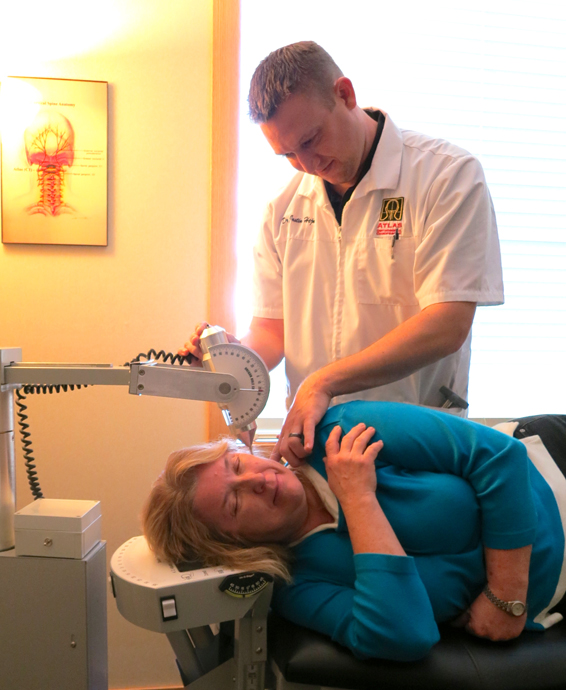
Atlas Orthogonal is a specialized upper cervical chiropractic technique that uses precision X-ray imaging to measure the exact position of the atlas before any correction is made. Adjustments are instrument-assisted, customized to each patient’s individual anatomy, and involve no manipulation, cracking, or twisting of the neck. It is practiced by a small number of board-certified chiropractors.
Our migraine chiropractor in Spring Lake Park, Dr. Hejny holds board certification in Atlas Orthogonal technique — a credential earned through advanced post-graduate training under Dr. Roy Sweat, the technique’s founder. It’s a distinction that matters, because Atlas Orthogonal is not a general chiropractic adjustment applied to the neck. It’s a highly specific protocol built around one region and one question: is the atlas sitting where it should be, and if not, what does the precise correction look like for this particular person?
The process starts with imaging — precision X-rays that map the geometry of the atlas relative to the skull and the vertebra below it. No two people’s anatomy is identical, which is why the correction is designed from that patient’s specific measurements rather than from a standard model. The adjustment itself is delivered with a small instrument, at a precise angle, with no force beyond what’s needed. Most patients describe it as remarkably quiet.
After a correction, patients rest for about 20 minutes before standing. This isn’t routine procedure for procedure’s sake — it gives the soft tissue surrounding the joint time to respond before movement resumes, which affects how well the correction holds. Follow-up visits monitor whether the atlas has maintained its position. If it has, no further correction is made. The visit still serves a purpose: it confirms that the structural situation is stable and healing is progressing.
What patients notice in the days and weeks that follow varies. Some report shifts in sleep quality before anything else. Others notice that the tension they’d stopped registering as unusual begins to ease. Some find that their physical symptoms change in quality or frequency. A few notice emotional shifts like better energy and mood due to fewer episodes.
None of that is guaranteed. Dr. Hejny is straightforward about that from the first conversation. What the evaluation offers is a clear answer to a question most people have never been asked — and a correction path if the imaging shows one is warranted.
Learn more about Atlas Orthogonal technique at Hejny Chiropractic
This Is a Conversation People Across the North Metro Are Having
The experience of chronic symptoms quietly wearing down mood and motivation isn’t unique to any one town or zip code. It’s something Dr. Hejny hears consistently from patients who drive in from across the Minneapolis north metro — from Blaine, Mounds View, Fridley, Coon Rapids, New Brighton, and Columbia Heights — often after years of managing symptoms without a clear structural evaluation.
What tends to connect these patients isn’t a single diagnosis. It’s a pattern: persistent symptoms, a thorough conventional workup that didn’t find anything actionable, and a gradual realization that the emotional toll — the low energy, the narrowing of life — has become its own problem. They come in not because they’ve given up on everything else, but because they’ve run out of obvious next steps and this is one they haven’t tried.
For people who have been looking for a chiropractor in Spring Lake Park or a specialist in the upper cervical region anywhere in the area, Hejny Chiropractic is one of the few practices in the metro with this specific level of Atlas Orthogonal certification.
If you’ve been dealing with this somewhere outside of Spring Lake Park and have been wondering whether the drive is worth it: the consultation is the right place to make that call. Dr. Hejny will tell you honestly at the outset whether the structural evaluation is likely to be relevant for your situation.

Is a Structural Evaluation Worth Exploring? What to Consider
Upper cervical care isn’t the right fit for everyone, and Dr. Hejny is clear about that from the first conversation. But there is a specific group of people for whom this kind of evaluation tends to be particularly relevant.
It may be worth a consultation if:
- You’ve been living with persistent symptoms — headaches, neck tension, dizziness, fatigue, or chronic pain — for a significant period without finding a satisfying resolution
- You have a history of head, neck, or whiplash injury, even one you don’t obviously associate with your current symptoms
- You’ve noticed your mood, energy, or motivation declining alongside your physical symptoms
- Your sleep has been disrupted in ways that don’t seem fully explained by stress or lifestyle
- You’ve had imaging or assessments that came back without a clear finding, and you’re still looking for an answer
The structural evaluation itself isn’t a commitment to a course of care — it’s information. It tells you whether the atlas is positioned in a way that warrants attention, and if so, what the correction would look like for your anatomy. That’s a worthwhile thing to know, regardless of what you decide to do with it.
Ready to Get the Structural Question Answered?
If you’ve been living with persistent symptoms in Spring Lake Park, Blaine, Mounds View, Fridley, Coon Rapids, or anywhere in the Minneapolis north metro — and the toll on your mood and motivation has started to feel as significant as the physical symptoms themselves — a consultation with Dr. Hejny is a useful next step.
He’ll tell you clearly whether the Atlas Orthogonal evaluation is likely to be informative for your situation. No pressure, no predetermined answer. Just a thorough look at the one structural region most workups leave out.
→ Contact Hejny Chiropractic in Spring Lake Park, MN to schedule your consultation.
Serving Spring Lake Park, Blaine, Mounds View, Fridley, Coon Rapids, New Brighton, Columbia Heights, and the greater Minneapolis north metro.
Frequently Asked Questions: Chronic Symptoms, Mood, and Upper Cervical Care in Spring Lake Park MN
Can chronic physical symptoms actually cause changes in mood and motivation?
Yes — and this is well-supported by research, not just anecdote. The American Psychiatric Association estimates that 35–45% of people with chronic pain also experience depression, and those with chronic pain are roughly four times more likely to experience depression or anxiety than people without it. The neurological pathways that process persistent pain and the regions of the brain involved in mood regulation share significant overlap. When one is under prolonged stress, the other tends to be affected.
The result is often a gradual flattening — not necessarily a clinical mood disorder, but a real narrowing of energy, motivation, and emotional bandwidth that compounds over time.
Why does chronic pain or tension affect energy and focus specifically?
The nervous system running a constant background pain-monitoring process is expensive — in terms of neurological resources. The systems that generate motivation, focus, and drive are drawing from the same pool. When the nervous system is persistently activated, those higher-level functions tend to get deprioritized. This is why people with chronic symptoms often describe a specific kind of fatigue that sleep doesn’t fully resolve, and a difficulty concentrating that feels disconnected from how much rest they’ve had.
How does the upper cervical spine affect mood and nervous system regulation?
The atlas — the topmost vertebra — directly houses the brainstem, which governs autonomic nervous system function, sleep regulation, stress response, and the neurochemical balance that mood depends on. A subtle misalignment at this joint doesn’t just affect local pain signals — it can keep the entire nervous system in a state of chronic low-grade activation, affecting sleep quality, stress reactivity, and emotional regulation in ways that aren’t always traced back to their structural source.
What is the Atlas Orthogonal technique and how is it different from regular chiropractic?
Atlas Orthogonal is a specialized upper cervical technique focused exclusively on the relationship between the atlas, the skull, and the vertebra below it. Before any correction is made, precision imaging is taken to map the exact geometry of the patient’s atlas — because no two people’s anatomy is identical. The correction is then designed specifically for that patient’s measurements. There is no manipulation, no cracking, and no twisting of the neck. It is practiced by a small number of board-certified chiropractors in the US.
Dr. Hejny holds board certification in Atlas Orthogonal, trained under Dr. Roy Sweat — the technique’s founder — making him one of the few practitioners with this level of specialization in the Minneapolis metro area.
Could upper cervical care help with the mood and motivation side of things, not just the physical symptoms?
Some patients do notice emotional shifts — improved sleep, less baseline tension, a bit more energy — as structural care progresses. This makes biological sense given the brainstem’s role in neurochemical regulation. That said, upper cervical care is not a treatment for depression or anxiety, and Dr. Hejny is direct about that. It addresses a structural question. What changes as a result of that structural correction varies between patients, and nothing is promised or predicted.
For people whose mood and motivation have been affected by chronic physical symptoms, getting the structural piece evaluated is a reasonable step — alongside, not instead of, any mental health or medical support they’re already receiving.
Does Hejny Chiropractic only see patients from Spring Lake Park?
Not at all. The practice draws patients from across the Minneapolis north metro — Blaine, Mounds View, Fridley, Coon Rapids, New Brighton, Columbia Heights, and beyond. The location off Highway 65 makes it accessible from most of the north and northeast metro. For people who have been looking for a Spring Lake Park chiropractor with Atlas Orthogonal specialization, or who are simply looking for this level of upper cervical expertise in the metro area, Hejny Chiropractic is a straightforward drive from most surrounding communities.
To schedule a complimentary consultation with Dr. Hejny, call our Spring Lake Park office at 763-230-0116. You can also click the button below.
 If you are outside of the local area, you can find an Upper Cervical Doctor near you at www.uppercervicalawareness.com.
About the Author